A Sensor can lie...
A sensor is normally purchased to measure one particular parameter, pressure, force, position, vibration, etc. But all sensors are affected by their operating conditions and part of its output signal will be due to these external influences. It may be varying temperature, acceleration forces, cable pickup,
extraneous loads....a whole host of factors which will corrupt your data and give large inaccuracies. Ensure that the sensor you buy is best suited to all the conditions it will experience and also make sure that all external conditions that will effect the final output are kept to a minimum.
A guide to Conductivity Measurement - FREE download
To help users improve the quality of their conductivity results, METTLER TOLEDO has produced a new Guide to Conductivity Measurements.
The 56 page guide provides users with practical tips and best practice examples as well as:
* Theory and measuring principles of conductivity
* Conductivity sensor selection guide
* Specific applications advice
Download Free Conductivity Guide >>
Online Unit Conversion Calculators
for Load/Force - Torque - Weight - Linear Displacement - Pressure - Acceleration - Volume - Temperature
click here >>
Online Calculators
Useful tools for Engineers from FUTEK - Advanced Sensors Technology, Inc.
Bolt Torque - Shunt Calibration - Span Adjustment - Unit Conversion - Zero Balance
To visit this informative website, click image...
Tech Note - Strain Gauge Selection
Designed to guide the reader through the various stages of successful strain gauge installation. Clear concise text, selection tables, reference charts and gauge pattern illustrations combine to ensure that this authorative work is essential reference
material for all those involved with strain gauges.
For your FREE copy, contact Measurements Group UK Ltd. at
+44(0) 1256-462131
FREE Dynamic Measurement Handbook
The Endevco Dynamic Measurement Handbook is a legend in the industry. Available in a handy pocket-size (9x16cm) the 60+ page compendium contains formulae,
tables, conversion factors and other technical data used in dynamic testing.
Visit our ON-LINE EXHIBITION, click here
How to fit an accelerometer
When fitting an accelerometer, ensure that its mounting face is completely flat and not on a curved or irregular surface. This allows the accelerometer to become part of the structure under surveillance and gives the optimum transfer of vibration levels into the sensor.
Accelerometer Mounting Considerations - A collection of four pages of PDF files for you to download - Click here
Accelerometers or vibration sensors can be mounted with a variety of methods to ensure that the vibrations are transferred as faithfully as possible into the sensor. Methods used include fixing with beeswax, hard adhesives (dental type glue), magnetic mounts and thread fixing (male or female).
(PDF files require Adobe Acrobat for display...this software is available FREE from Adobe, if Acrobat is installed on your system, the program will automatically run on file selection.)
click image to download your FREE copy of Adobe Acrobat
Tips and Techniques for successful Condition Monitoring
A recently released booklet written by Roger Dunn....a practical guide to Vibration Monitoring in predictive maintenance. Ideal for both newcomers and experienced engineers to this scientific approach to protecting important factory machinery.
For your FREE copy, email your address by clicking here.
Avoiding Pressure Overloads
Pressure transducers can be easily overloaded by surge pressures and transients of which the user is completely unaware. These surge pressures can be many times greater than the static overload performance of the sensor. Ensure that the sensor is protected from such transients such
as by fitting snubbers.
How to fit a load cell
Mounting a load cell correctly is important to ensure that its performance is accurate and repeatable. Many load designs exist, with some models accepting a certain degree of extraneous loading, but it
recommended that its mechanical fitting is flat and secure with the load being applied vertically through the cell.
Understanding linearity
There are several ways to interpret and represent linearity of a transducer. Those most commonly used are... End point linearity, Best fit straight line (BFSL), and Least squares BFSL linearity.End Point Linearity
From the graph plotted of Voltage Output against Increase in Measurand which usually appears as a curve, a straight line is drawn from the zero point to the full scale output point. Usually the point which deviates most from the simple straight line will be used to specify the 'linearity' of the
transducer. This is quoted as a percentage of the normal full scale output of the transducer.Best fit straight line method of definition
In practice, the relationship between the measurand and the output of most transducers is not perfectly linear and it is therefore necessary to find a way of using these devices to achieve the most accurate overall results. This can be achieved by constructing what is known as the "Best fit straight line" (BFSL) through the calibration points in such a way that the maximum deviation of the curve from the line is minimised as indicated in the figure below.This diagram simply illustrates how, instead of drawing a straight line between the origin and the end point at "B", we can construct a line
which effectively halves the maximum deviation that would appear at point "A" and shares it with the end point at "B". Thus the deviation from the BFSL, and hence the linearity error, is effectively halved.
However, it should be appreciated that this is simply a means of interpretation of the results and relies entirely on the system, including the measuring equipment, being set up to take advantage of this technique.
To take advantage of this method in the case illustrated, it Is necessary to set up the system so that when the transducer is at full scale 'y' at point 'B' the indicated output would be set to a value of 'x'. This then effectively halves the error indicated at 'A' which would now deviate from the BFSL by the amount rather than if we had simply constructed an 'end point straight line'.
It can be clearly seen that this enables us to effectively halve the errors in the system and thus record better results over the whole measuring range. Note however that although it is quite easy to construct a BFSL on a graph of transducer output against measurand, it is not so easy to do when faced with
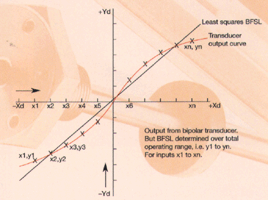
a simple set of figures. In practice we need a better, quicker and more consistent means of determining the BFSL which can also take into account transducers with bi-polar outputs such as LVDTs and tension/compression load cells.The answer to this problem is the 'Least squares method' of determining the BFSL. This is a statistical method, which enables the BFSL to be determined mathematically over any chosen working range, and is the most suitable method for use in computerised calibration systems.
Least Squares Best Fit Straight Line Method
In the previous issues of Transducer Action, we have discussed 'End point linearity' and 'Best fit straight line' methods of definition. Our concluding article deals with the 'Least Squares Best Fit Straight Line' method, preferred by most transducer manufacturers because it provides the closest possible best fit to all data points on the curve, and can be most readily adapted to the computerised calibration systems in common use.The Least Squares Best Fit Straight Line is a statistical method and as such may not be a 'purist' approach but provided the characteristics of the transducers are correctly optimised at the design and development stage and are represented by a continuous smooth curve, the assessment is meaningful and accurate.
In practice, up to 20 calibration points will be taken over the whole working range of the transducer and the measured input and output values at each point used to provide the data for calculation of the slope of the 'Least Squares Best Fit Straight Line' using the following equation:
Where: Xd = known input data points
Yd = actual sensor output at each Xd data point
n = number of data points
Having mathematically determined the slope of the best fit straight line it is then possible to determine the maximum deviation of any point from this line using the equation:
where fr = full working range
As with all other methods the maximum deviation value would be expressed as a percentage of the total linear range of the device. It should be noted that since this evaluation is done over the total range of the transducer the best fit straight line may not pass through the zero point of a bipolar device such as an LVDT, Universal load cell, differential pressure transducer etc. However, this does not
have any great practical significance since the zero output point is usually adjustable electronically anyway.In general it can be readily agreed that this method is by far the most efficient one, but it must be used with care and understanding. Clearly because of its statistical nature, the number of data points taken will have a direct bearing on the ultimate validity of the assessment. In practice, the more uneven the characteristic curve, the more data points must be used in order to take the incremental non-linearity into account.
Periodic Check of Humidity Sensors
Improve the accuracy of relative humidity (RH) sensors, which can be affected by both soluble and insoluble contaminants, by ensuring that periodic checks are made of response, accuracy and calibration.
Temperature effects on Pressure sensors
Many process applications for pressure sensors demand that accurate results must be achieved either under extreme temperatures or under conditions where temperature fluctuates dramatically.Different types of sensor are affected by temperature in different ways. With thermal hysteresis (often defined as thermal stability) being a particular problem. For example, silicon devices can be susceptible to differential expansion between the various materials used in their construction, while
bonded gauge devices cannot be used in areas of high or low temperatures, as the bonding materials will either soften or become brittle.Other, perhaps more subtle effects resulting from changes in temperature include non-linear errors in output measurements. By comparison, thin film sensors generally exhibit high levels of long term accuracy, with linearity and hysteresis remaining constant as temperature changes.
Transducers are affected by moisture
This can be caused by a high level of vapour in the surrounding atmosphere, by the need to immerse
the device in water or simply because the end cap has been removed on site.
In each case, it is important to ensure that the trasnducer and connectors are sealed to IP or similar standards, and that both the electronics and the gauge structure itself have been selectively coated with a moisture resistant material such as silicon dioxide.
FREE Pressure Conversion Slide-Chart
For your FREE slide-chart, email your address details to sales@variohm.com
Radar level measurement
The user's guide by Peter Devine
The guide is a full and comprehensive publication in full colour hardback A5 format covering the following:Part I
1. History of radar
2. Physics of radar
3. Types of radar.
Part II
4. Radar level measurement
5. Radar antennas
6. Radar level installations
a. Mechanical installation
b. Electrical installation
Part III
7. Other level techniques:
Amongst others, DP transmitters, Capactive transmitters,
Electromechanical transmitters and Ultrasonic.8. Applications:
Covering applications in the following industries: Brewing &
Distilling, Cement, Chemical, Food, Metals, Offshore,
Pharmaceutical, Power and Water & Waste water industries.
Part IV9. VEGA radar
Two wire loop powered radar
Vegapuls 50 - technical specification
Vegapuls 40 - technical specification
Vegapuls 40 & 50 options
Echofox software
The book also has additional appendices, which cover the
following: Glossary of terms, Radar power & radar power density,
Dielectric constants Symbols, Photograph acknowledgementsTel: Vega Controls - +44(0) 1444 870055
The effects of Water Hammer
To find out more about the phenomenon of Liquid (Water) Hammer in pressure measurement, click here for an informative article by Danfoss Limited.
Calibrating a smart HART device.
This step-by-step guide to calibrating a 'smart' pressure transmitter assumes that it is isolated from the process, is not electrically connected to a loop power supply, and is configured for psi units.1. Power on the DPC and display the basic HART information for the transmitter.
2. Configure the DPC by selecting MEAS mA, SOURCE psi to measure the analog mA output and the pressure being applied simultaneously to both the transmitter input and pressure module.
3. Vent the pressure line and clear the pressure module to zero. Select the instrument for a linear transmitter calibration and fill in the appropnate test tolerance.
4. Apply the input pressures as instructed. When the test is complete, an error summary table is displayed. Test errors exceeding the tolerance will be highlighted.
5. If the As Found test failed; i.e., there were highlighted errors in the error summary table, adjustment is necessary.
6. Zero the pressure module (vent to atmosphere). First test the Lower Trim value.
For best results, apply the LRV pressure and retrieve the value being measured by the pressure module. Then move to the Upper Trim. As before, apply the URV pressure.7. Next perform the Output Trim. The value of the primary variable (PVAO) is normally a 4 mA signal. Load the measured mA value. Send the value to the transmitter to trim the output section for the
4 mA value. Repeat for the 20 mA trim. After completing Output Trim, carry out the As Left verification test. Apply the requested pressures. Upon completion an error summary table is displayed.
If none of the errors are highlighted, the transmitter has passed the As Left test. If errors are highlighted, the test has failed and further adjustment is required.
Return to step 5.
FREE download of software for inputting, logging and chart plotting sensors data through the games port of a PC. To get your FREE copy, click here...
1FREE Vibration Conversion Slide-Chart
For your FREE slide-chart, email your address details to trohrer@ctconline.com
For Glossary of Terms page, click here ...
Click image to find out more about CALISO CALIBRATION TOOLBOX, a Windows based Calibration Management Program for Scientists and Engineers
If you wish to contribute to this section, please email your entry to editor@sensorland,com

Designed and managed by Copidate Technical Publicity
Webmaster: Mike Coope
Telephone: +44(0)1902 700426
Email: mike@sensorland.com
(For site details and costs, click Sensorland)
Copidate shall not be held responsible for information presented on this site.
© Copyright of Copidate Technical PublicityDisclaimer:
Our web site may contain links that make it easy for you to visit other sites which might be of interest to you. If you use the links to leave our web site and visit a web site operated by somebody else, you should note that we do not have any control over that Web site. Accordingly, we cannot be responsible for the content or protection and privacy of any information which you provide while visiting such sites. You should exercise caution and look at the Privacy Statement applicable to the web site in question.