Grounding and Shielding Considerations for
Thermocouples, Strain Gauges, and Low-Level Circuits
INTRODUCTION
Signal to Noise Ratio
Electrical noise is present in all measurement systems to some degree. Instrument engineers typically design systems that make the measured signal much larger than the noise that accompanies it, whatever that source of noise may be. They specify this parameter as signal-to-noise ratio SNR and typically measure it in dB. In terms of voltage, dB = 20 log (V2/V1), where V2 is greater than V1, and V1 is the noise level.
For example, 120 dB is a ratio of 1,000,000:1 and 160 dB is 100,000,000:1, very respectable numbers for SNRs. Design rules that instrument manufacturers follow to make noise-free and quality equipment include proper circuit design and layout on a printed circuit board as well as grounding, shielding, and guarding. One common method for measuring low-level signals where noise can be a problem is to use differential input amplifiers.
The topology of such circuits tends to cancel certain types of noise. Both terminals of a two-terminal sensor connect to the differential amplifier input, and shielding and guarding circuits typically connect to signal ground and special guard-shield terminals. This eliminates current flow between the grounds, common, or returns of the sensor and the instrument input amplifier, which can generate noise signals. One drawback when using differential inputs is that only half the number of sensor inputs is available compared to a single ended configuration. That is, one differential amplifier consumes two single-ended input connections.
DISCUSSION
High SNR is particularly critical for strain gauges and thermocouples, which inherently have relatively low signal levels compared to most sensors. These sensors deal with millivolts and microvolts, signals already close to the values of typical noise levels that can be measured in test setups. By comparison, many transducers have 1V, 5V, and 10V standard output levels.
Thus, 10V compared to 1 microvolt is 10/0.000001, that is, 10 million to one or 20 log (10/0.000001) = 20 log (10,000000) = 20(7) = 140 dB. But a 1.0 mV signal compared to a 1 microvolt level of noise is much more serious. Here, 0.001V is compared to 0.000001V, or 20 log (0.001/0.000001) = 20 log (1,000) = 20(3) = 60 dB. In other words, the SNR for the first example is 10 million to one, and the second is only 1 thousand to one. So, maintaining a high signal-to-noise ratio is paramount in low-level signal circuits to prevent the measured variable from being contaminated or yielding inaccurate results.
PROCEDURE
Data acquisition system designers try to obtain the highest SNR as possible within their equipment with the resources available to them, but users also have an equal responsibility for reducing noisy signals and maximizing instrument measurement accuracy. Several such factors under user control that play a significant role in reducing noise levels, increasing SNR, and improving accuracy include transducer lead length, application of grounding points and shields, and the temperature coefficient of copper wire.
General Precautions
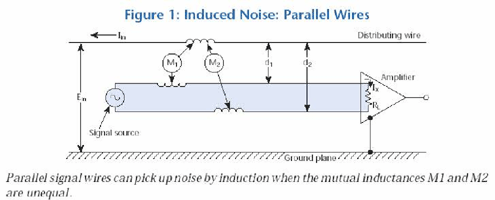
Short leads between sensors and amplifier inputs are the first consideration in minimizing noise. Long leads act as antennas and can pick up a variety of electric and magnetic interference. Although strain gauges and thermocouples have characteristically low impedances, it is still good practice to use short leads and twist them together. Figure 1 illustrates a condition where unshielded, parallel wires connect the signal source to the amplifier input. The parallel wires pick up noise through induction from the radiating wire principally because the mutual induction M1 and M2 are unequal as are the distances, d1 and d2.
Figure 2 shows how to cancel or minimize the interfering noise by twisting the wires. Moreover, thermocouples should use thermocouple lead wire rather than ordinary copper wire since TC wire is designed just for this application.
In most cases, the special lead wire may be obtained from the thermocouple manufacturer or supplier.
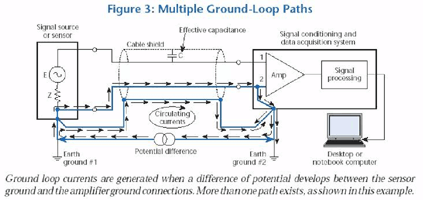
The second consideration is the ground point. Usually, a ground connection is made at either the amplifier input or preferably the sensor, but definitely not at both. When both devices are grounded, a small but measurable "ground-loop" current can flow between them and manifest in an unwanted noise signal at the amplifier input terminals. The best policy is to follow the manufacturers grounding recommendations for its particular instrument and sensor.
The circuit in Figure 3 shows a potential difference between earth ground #1 and earth ground #2. As a result, two ground loop paths are generated when the shield, sensor return, and sensor shield are all grounded to earth ground #1, and the other end of the shield, the sensor return, the common amplifier terminal, and amplifier chassis are connected to earth ground #2. One circulating current runs through the shield conductor, and the other runs through the signal return (or common) wire.
Figure 4 shows that the ground loop current through the shield is eliminated when its ground connection is removed from earth ground #2. Likewise, the loop current in the signal return path is eliminated when the ground connection is removed from terminal 2 of the amplifier. In addition, wires shielded with copper, aluminum, and tin can minimize most electrical interference, but ferrous materials may be needed to shield wires where high magnetic fields may be present. Copper or aluminum shields alone may not be effective enough. Moreover, grounding these shields require as much care as other shields to minimize ground loop currents that can appear as signals to the amplifier input terminals.
Copper wire has a relatively high temperature coefficient of resistance. However, it tends to be neglected when the sensor signals are so large that any changes in impedance due to the wire’s temperature coefficient have negligible effect. But in high impedance, low-level circuits, or circuits with long lead wires, the wire resistance by itself or with a change temperature can be significant and affect the measurements by as much as 10% or more. In many cases, however, wire resistance effects can be cancelled by using a four wire system where one pair is the "excite" wires, and the other pair is the "sense" wires, such as used in bridge circuits.Thermocouples
Thermocouples should be electrically isolated from the device under test where possible to avoid ground-loop currents, common-mode voltage problems, and induced voltage or current. However, most thermocouple instrument amplifiers provide ungrounded temperature reference input terminals mounted on isothermal blocks that help minimize such noise problems. For example, Figure 5 shows the temperature compensated isothermal block and input connections to the IOtech DBK81™ series of thermocouple amplifiers.
When thermocouple wire leads must be shielded, use the shield connection provided at the input to the amplifier, and do not connect the other end of the shield (at the device under test) to a ground. However, when the thermocouple must be grounded, use the same ground terminal to connect to the shield and do not use the shield connection at the amplifier end. (Remember, the shield must not be grounded at both ends.)
Strain gauges
Strain gauges (and frequently, thermocouples) are fastened mechanically and sometimes electrically to the device under test. This arrangement can set up a path for ground loop currents and common-mode voltage noise signals. Use non-inductive types of strain gauges and ground the shields only at the sensor end. Use the differential input terminals of the data acquisition system and make certain that neither terminal is inadvertently grounded through an inconspicuous "sneak circuit."
Figure 6 is an example of a situation where a differential amplifier input is selected but the cable shield is connected to the amplifier common. The common-mode voltage Ecm appears between signal ground and system ground. The distributed capacitance in the cable shield shunts the amplifier input impedance to ground and sets up a noise current (Icm) path through the signal source.
Removing the connection from the shield to system ground at the amplifier input and connecting the shield to the signal ground at the sensor as shown in Figure 7 reduces the effect of cable capacitance and prevents common mode current, Icm, from flowing through the signal source. In this way, the systems common mode rejection ratio is greatly improved.
Strain gauges and other bridge circuits used with strain gauge modules such as the IOtech WBK16™ are not usually grounded. The WBK16 uses differential input amplifiers with excitation voltage supplied by isolated and current-limited power supplies to help minimize noise problems. However, when strain gauge wires need shielding, use quality cable, such as the CA-177 stain gauge cable, and connect the shield to the DB9 metal shell. The shell does not return to common ground, therefore common mode voltage and current cannot interfere with the measured signal. Also, use twisted pair cable with paired leads for signal input, excitation output, and remote sense input.
See Figure 8, the block functional diagram of the WBK16, for an example showing connections to a full-bridge strain gauge. Occasionally, some of the above precautions cannot be followed implicitly. When in doubt, the best procedure is to use the differential input terminals to the data acquisition system rather than single-ended inputs, and connect the shield to the sensor or signal source common terminal.
Other Considerations
The impedance of a signal source should be much lower than the amplifier input impedance to ensure high system accuracy. As the signal source impedance approaches zero, so does the amplitude of the noise signal to the amplifier. However, in most cases, users need not concern themselves with these issues. Most data acquisition system manufacturers have considered such loading problems and offer specific signal conditioning amplifiers that match transducers and special circuits.
For example, signal conditioners are available for thermocouples and strain gauges that offer the proper impedance matching and temperature compensation. However, in signal conditioners that have more general capabilities such as measuring voltage, current, and resistance, the sensors or signal sources are not necessarily specified, and users should consult the data acquisition system manufacturer to ensure that they purchase the proper signal-conditioning amplifier.
For example, not all general-purpose voltage amplifiers are designed to work with strain gauges, bridge circuits, and some other transducers or circuits, especially those that could exceed the common-mode voltage rating of the amplifier input. It’s also a good idea to discuss your test setup with an application engineer to ensure that you will be properly connecting and grounding your data acquisition system to the signal source, even when you feel confident you have made the right decision.
Source Impedance Calculations
For non-specified voltage and current measurements, the source impedances must be known in order to select the appropriate signal conditioner. Usually, the transducer manufacturer provides a data sheet with the device that specifies its impedance and how it is determined. When this is not available, a number of empirical methods may be used to determine the source impedance. One method, shown in Figure 9, is to measure the open circuit voltage output with a known high impedance voltmeter.
Next, connect a known impedance to the same terminals and measure the voltage and current under load. (Make certain that the impedance selected is not so low as to cause the current to exceed the device’s rating.) The source (internal) impedance can be calculated form the equation:
Zi = Ze(V2–V1)/V2
Where: Zi = internal impedance, Ohms
Ze = known external impedance, Ohms
V1 = measured open-circuit output voltage, V
V2 = measured closed-circuit output voltage, VTypical Environments and Tips
Electric motors, generators, and large transformers can present unique problems. Large electromagnetic fields may be coupled to sensor leads and induce noise. When measuring motor or generator vibrations with accelerometers, notch filters may be used at the amplifier input leads to eliminate 60 Hz signals that may be induced. This is not a problem when the vibration frequencies of interest are in the range of hundreds of Hz.
In addition to ac interference, dc motors and generators produce interfering magnetic fields as well. Use the same shielding recommendations as discussed above, using copper, aluminum, and ferrous materials as appropriate for the environment.
Article kindly provided by ICP Systems Ltd.
For details of Sensor Suppliers, click here...
Home - Search - Suppliers - Links - New Products - Catalogues - Magazines
Problem Page - Applications - How they work - Tech Tips - Training - Events -