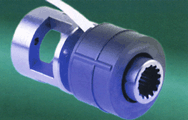
The Torqstar Torque Sensor
The importance and usefulness of torque measurement in fastening and other applications has been recognised for many years, but the challenge in the past has been to monitor and measure torque both accurately and
economically in the manufacturing environment.Although strain gauge torque transducers provide high accuracy, their high cost and bulkiness are features which have limited their use primarily to research and development laboratories and in quality assurance testing in order to verify standards. In addition, such transducers require high
maintenance levels, making them unsuitable for mass integration into manufacturing systems.Low cost methods have been tried to control torque in the manufacturing environment, including non-direct systems which, for example, monitor changes in electrical power consumption. But such methods typically provide poor resolution and are not accurate enough to be useful.
The new Torqstar sensors meet the challenges for sensors to be used in manufacturing environments and can now be designed directly into production equipment. They cost up to 60% less than comparable strain gauge methods. The accuracy of the new transducers is within 0.5% of full scale, comparing favourably with strain gauge units costing almost five times as much, and they offer a compact size and rugged construction.
Torqstar transducer fitted
directly in tightening head
for tops and caps on bottles,
tubes, cans and jars.
Both rotary and reaction transducers are available in the range 6-120 Nm, and units can be readily adapted to a wide range of applications. A prime example is equipment for tightening tops and caps on bottles, tubes, cans, and jars, ensuring that these are tightened to just the right
torque.Another growing application is in monitoring electric motor efficiency. Worn bearings or over-tight shafts on equipment such as fans or blowers increases operational costs significantly. Fitting Torqstar sensors to motors as standard is now a practical reality.
Monitoring machine tool efficiency is another important application where Torqstar transducers can important role. Worn or blunt tools increase machining times and require more power. This can lead to broken tools, increase in machine wear and poor quality parts.
Torqstar sensors can be integrated into machines to monitor efficiency and prompt timely tool replacement or sharpening.
Further potential applications for these sensors are enhanced when they are coupled with position or speed encoders, or rotation counters. In threaded assembly operations such as bolted joints or bottle capping, these combined technologies deliver not only accurate and consistent tightening torque, but can also detect cross-threading or under/over size
threads.
The sensor is made up of two
main components:
A stainless steel shaft,
dimensioned for the appropriate
torque, and a second metal ring,
which fits tightly on the shaft.
Although the ring appears to be
normal steel, it is actually a
special titanium-nickel material
which has the property of being magneto-elastic.Magneto-elastic materials are commonly known as pseudo magnets. When at rest, they produce no external magnetic fields, but as soon as their form experiences a change in shape through applied stress, their magnetic characteristics change to give a field whose strength is directly proportional to the applied stress.
The ring of magneto-elastic material is magnetised circumferentially. Without an applied torque, the magnetic field is contained wholly within the ring. However, as torque is applied to the shaft, the magnetic field twists within the ring and field lines intersect with the surface of the ring
in proportion to the amount of torque applied.The size of the magnetic force is measured by means of a fluxgate magnetometer (FMG), which is an integral part of the electronics package. The FMG measures and converts the force to an electrical signal. Unwanted external magnetic fields are blocked out by the Torqstar enclosure.
From an article from Variohm
For more details, call +44(0) 1327 351004
For details of SENSOR Suppliers, click here...
Home - Website - Search - Suppliers - Links - New Products - Catalogues - Magazines
Problem Page - Applications - How they work - Tech Tips - Training - Events - Jobs